
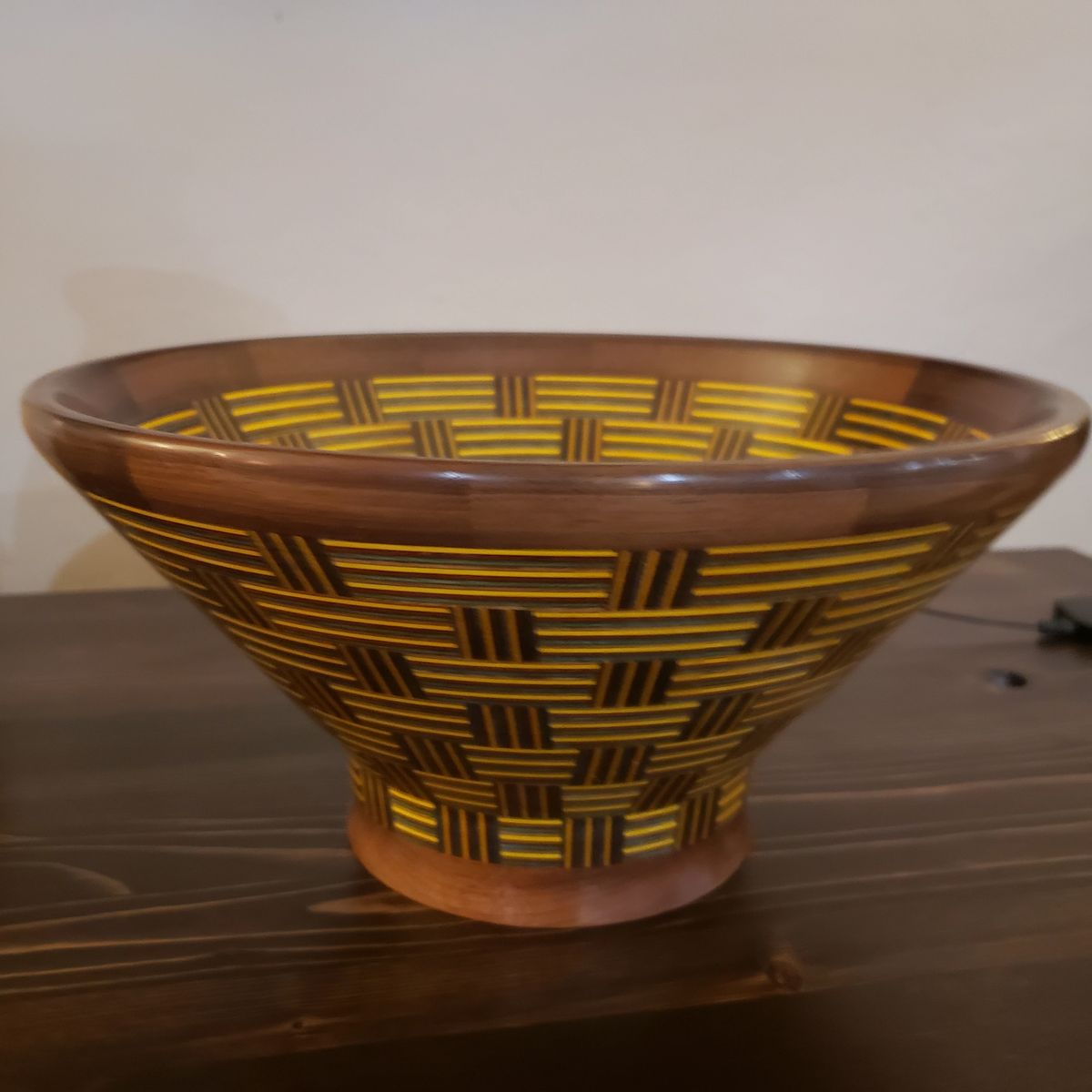
Basket weave turnings

Vessels whose walls read as woven basketry, built from interlocking blocks of contrasting timber and veneer.

A flared wooden bowl with a walnut rim and a body patterned to look like woven basketry in gold and dark brown

These pieces borrow from basketry rather than pottery. Blocks of contrasting material are offset row by row so the surface reads as an over and under weave, even though every part of it is rigid glued timber.

Building a weave

A weave pattern only works if the offsets are exact. Every row shifts by a set fraction of a segment, and the rhythm has to hold all the way around the circumference and all the way up the form.

The illusion is helped by the direction of the grain. Turning a laminated block end on gives fine parallel lines, and alternating that direction between neighbouring blocks is what makes one appear to pass over the other.

Left in solid hardwood the effect is quiet and warm. Built with dyed veneer it becomes graphic, which is why several of these pieces pair a plain turned rim with a strongly patterned wall.

1

Offset row by row

Every row shifts by a set fraction of a segment, holding the rhythm around and up the form.

2

Grain direction does the work

Alternating the grain between neighbouring blocks is what makes one appear to pass over the other.

3

Solid or dyed

Left in hardwood the weave is warm and quiet. Built with dyed veneer it turns graphic.

How a piece is made

Nothing here is carved or painted. Every pattern is cut, arranged and glued into the blank before the form is turned away.

STEP 01

Choosing the wood

Domestic hardwoods and imported exotics, chosen for colour, availability and sustainability.

STEP 02

Cutting the segments

Boards are cut down into many smaller pieces, ready to be rearranged into something new.

STEP 03

Building the blank

Those pieces are arranged and glued up ring by ring into the form that becomes my blank canvas.

STEP 04

Turning the vessel

The shape emerges on the lathe, and the pattern built into the wood appears with it.
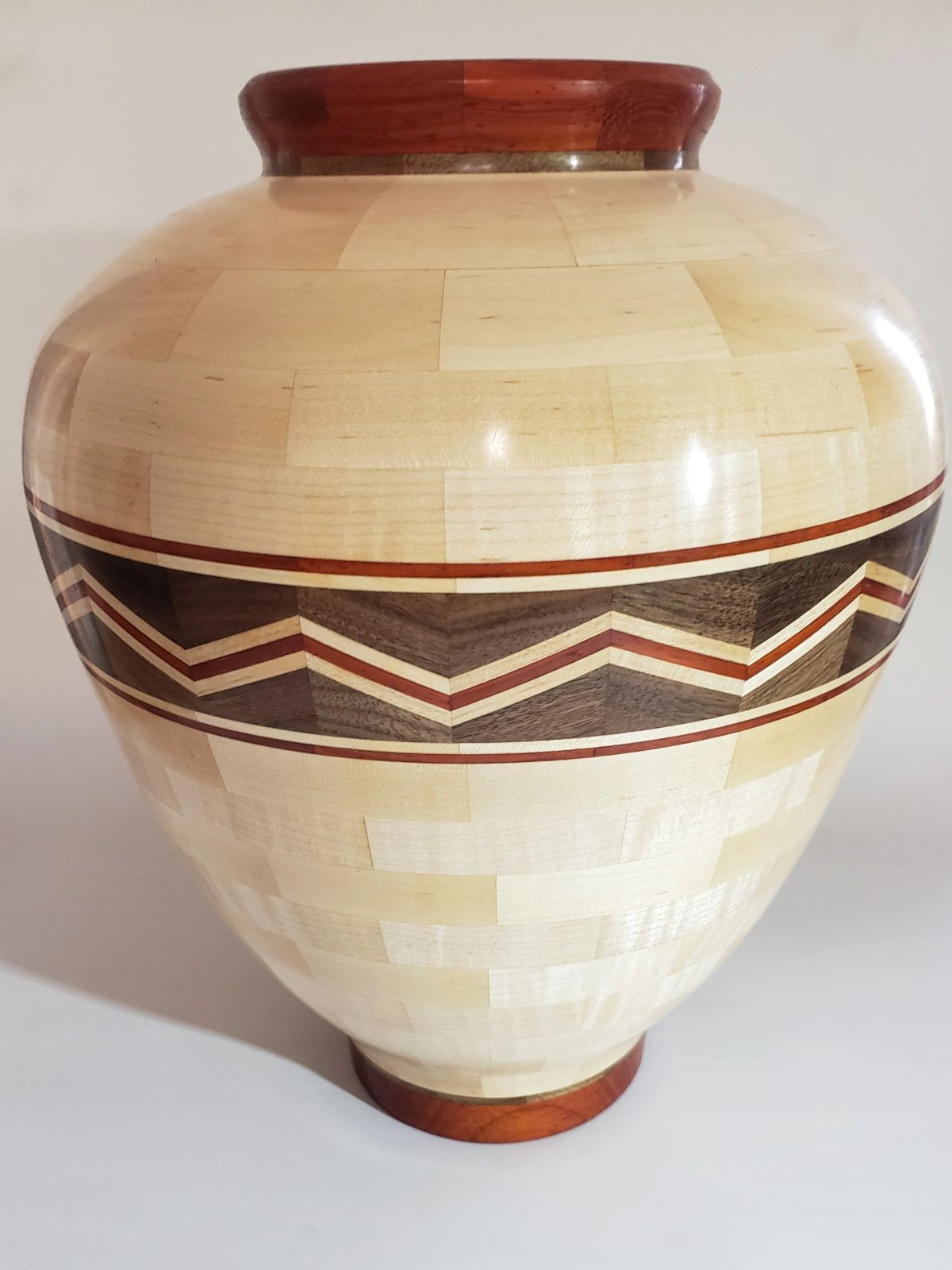
No stains, no paint

Everything you see in these vessels is timber. The colour, the pattern and the line all come out of the wood itself and the way the blank was built.

A tall segmented wooden jar in pale maple with a chevron band of walnut and padauk around its widest point

Colour that comes from the wood

No stains and no paint. The natural colours in these woods are what make the patterns possible.

Sustainably sourced timber

Wood harvested from sustainable forests and managed plantations running sound reforestation programs.

Turned one at a time

Each blank is built and turned individually, which is why no two vessels ever come out the same.

Ask About A Piece

Question? Answered

How the work is made, what goes into it, and how to get hold of a piece.

It is a technique known as polychromatic woodturning, or segmented construction. Boards are cut into many smaller pieces and rearranged into a form that serves as the blank canvas. That blank is then turned on the lathe, and the pattern built into it emerges as the shape is cut away. My current work is exclusively segmented turning.

A combination of domestic and exotic woods from around the world, selected for colour, availability and sustainability. Most of the exotics and imported woods come from local suppliers in the Phoenix area, and the American hardwoods come from resellers of the same species furniture has been built from for generations. Newer pieces also incorporate dyed birch veneers.

No. The natural colours in the woods are what allow the patterns and designs in the bowls, pots and vases to be created. Where you see stronger colour, such as the blues and oranges, that is dyed birch veneer laminated into the blank rather than a finish applied to the surface.

Yes. Domestic shipping is free on all orders over $350.

I exhibit at fine art festivals around Arizona. For 2026 that is the Wigwam Festival of Fine Art in Litchfield Park in February, the Fountain Festival of Fine Arts and Crafts in Fountain Hills later that month, and the High Street Arts Festival in Phoenix in March. Full dates and times are on the Shows page.

Still have questions?Read all FAQ’s

Seen something you like?

Every vessel is one of a kind. Send me a note about a piece, or come and find the booth at one of this year's Arizona shows.

Ask About A Piece

FREE DOMESTIC SHIPPING OVER $350

SEGMENTED, ONE-OF-A-KIND VESSELS

TURNED IN PHOENIX, ARIZONA

Expires in

Limited time offer

We rebuilt your site for you. Claim it and we handle everything transfer, hosting, and your domain. Then update it anytime, just by asking AI.

Host for only$8 per monthBilled yearly
Claim limited offer now